
Emma Raz - Where the Money is in Podcasting, GDPR Privacy Laws, How Demographic Data Works, and What’s Next for Video
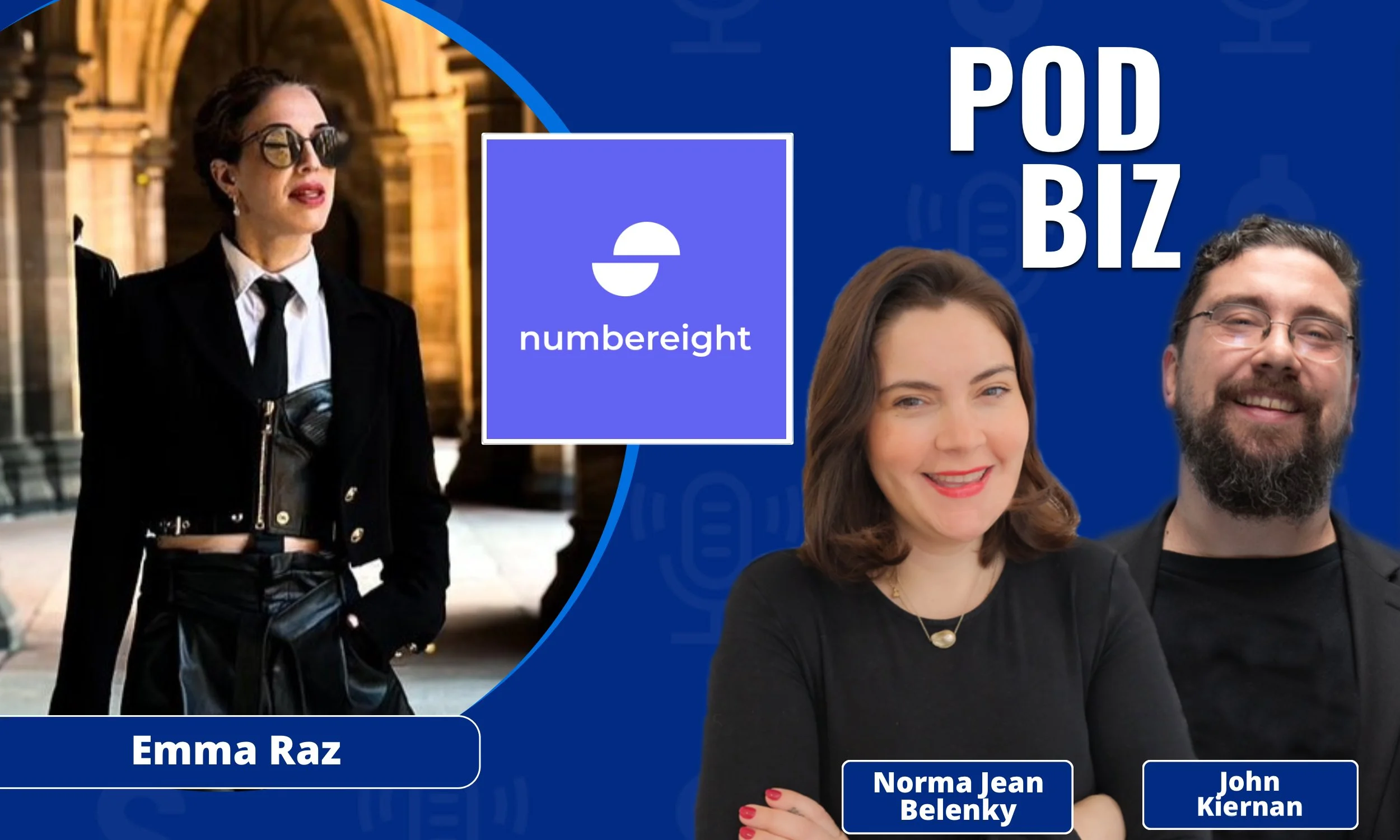
Emma Raz, Director of Commercial at Number Eight, sits down with hosts Norma Jean Belinsky and John Kiernan on PodBiz to discuss how audience demographics are compiled using advanced technology, where advertising dollars are moving in podcasting, European data privacy laws (GDPR), building privacy-first ad solutions, her career journey from managing hardware factories in Taiwan to ad tech, and what's next for video podcasting.
Where is the money in podcasting right now?
“That's a really good question. I think the money in podcasting is changing. A lot of the money came from mostly sponsorship, mostly direct engagement with the host. We've seen more and more money starting to flow towards programmatic over the years. Now it's not new, but we are seeing a bigger chunk moving there and also new ways to combine programmatic with host-read—whether doing audience extensions, lookalikes, or buying host-read in a more programmatic manner. We've seen podcasting evolve from being an audio-only format to now really heavily growing within video.”
For listeners in the US, what is GDPR, and how does it impact data collection?
“GDPR is the General Data Protection Regulation, basically European technology privacy laws. The advantage of being European is that we were born post-GDPR. We inherited very strict policies from the get-go and had to live under those limitations, which means that we need to think about things differently. Often limitations lead to innovation, and that kind of paved the way for us to think about data in a different way than how other big data companies have traditionally thought about data.”
How is Number Eight’s approach to gathering demographic data different from traditional methods like IP matching or surveys?
“If you look at traditional data, there are two main methodologies currently available in podcasting: IP-based matching and surveys. IP matching identifies a household at best, which means various things when you think about demographic data, which is individual-level data. Surveys are expensive to scale, and humans have the limitation of not remembering what they listened to.
The way that we approach it is very different. We have a piece of software—an SDK (software development kit)—that goes into publisher apps. That software harnesses hardware sensors, like the gyroscope and accelerometer. From that, we get behavioral data, logged-in demographic profiles, and real content consumption. Instead of asking what you listened to, we see what you listened to and match that accordingly. That allows you to create podcast content consumption ‘neighborhoods’ across millions of users, which is much bigger and more reliable than a survey.”
What audience demographic trends are you seeing in podcast consumption?
“Overall, podcast consumption heavily leans toward Millennials, who represent the majority of consumers, though both older and younger audiences are increasing. Demographics generally show a 50/50 male-to-female split, with variations by market. You'll see variations by market in top content—some markets lead more to business and finance audiences, while others lead more to lifestyle, parenting, or true crime.”
How are advertisers and publishers using this data?
“There is a mix of ways. Some people select demographic buckets and activate, but we also have people using our planning services to recommend audience combination strategies. Podcasts and networks also use our data to analyze who their audience is so they can better pitch to brands. Most recently, the request has been to create parity for video podcasting, like YouTube.”
How did your career journey bring you into the podcasting industry?
“My first real job was in cybersecurity managing factories in Taiwan, all in hardware. Managing millions on a monthly basis under high pressure allowed me to develop a thick skin and a degree of confidence. From there, I moved into digital performance advertising with AppNext, building new markets and channels. During COVID, I joined Number Eight as the first commercial hire when we were still figuring out our sales structure.”
What core mindset or value has made the biggest impact on your career?
“I believe that my word matters, and if I promise something, I have to deliver it. When you are starting early, people don't trust the company yet because it doesn't have a track record; they trust you. Your reputation builds the company's reputation. If I say we're going to do something, we're going to do it.”
What is something people don't know about Number Eight?
“We're still very small and have been the same size for many years, prioritizing efficiency to a ruthless degree. But it's deeply human. We stand by our employees and put them first, backing people when they face struggles rather than turning away. We try to live the values of privacy-first technology internally in the way we work.”
What is a strategy or decision that really worked for Number Eight?
“Entering podcasting was one of our biggest successes. Podcasting turned out to be fertile ground because data was fragmented and scarce, so there was a huge need for it. Second is doing everything in partnership. We are very collaborative, which allows you to amplify your message tenfold because you have other people working with you.”
What is something that didn't go to plan, and what did you learn from it?
“When I first joined Number Eight, mobile IDs and cookies were expected to be deprecated immediately, which was supposed to completely revolutionize the industry. It didn't pan out as an overnight switch-off. That forced us to pivot and shift our focus, which is ultimately how we ended up entering podcasting and developing our audience solutions.”
What are you most excited about for the future of podcasting?
“Video data parity. How do you create seamless activations across formats, channels, and walled gardens? We want to make advertisers' lives easier, answer tough questions around scale estimation and incrementality, and allow budgets from traditional media and digital channels to easily flow into audio.”
Please support our sponsors:
Lean and Loaf - Your one stop shop for podcast video and audio post production. www.leanandloaf.com
PodSEO - A specialized competitive intelligence and growth platform designed to optimize podcasts for search engines, listening apps, and AI assistants. www.podSEO.com
A thank you to our media partners:
Podnews - Daily news for the podcast and on-demand audio industry. www.podnews.net
Headliner / Disco - Disco converts your readers into podcast listeners. Quickly create, clip, and caption podcast videos with ease. Turn 1 full-length video into 10 optimized, accessible podcast clips. www.headliner.app
