
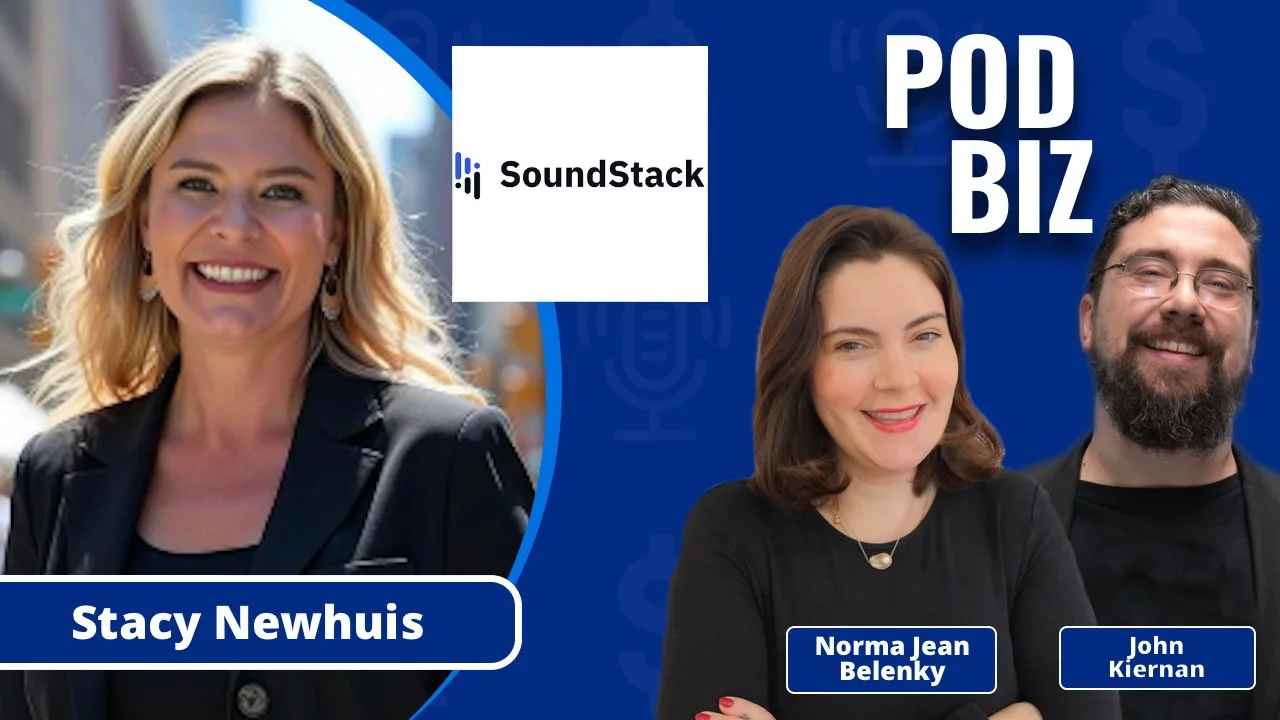
Stacy Newhuis, Senior Vice President of Marketplace at SoundStack, sits down with host Norma Jean on Podbiz to share deep industry insights on podcast monetization, dynamic ad insertion, and programmatic buying trends. In this episode, she breaks down the mechanics of reach extension, how publishers can continuously monetize their back catalogs, why SoundStack remains tech-agnostic, and how lessons from solo travel and "unreasonable hospitality" shape high-performing teams.
Where is the real money in podcasting right now?
“I would say for SoundStack, it would be in reach extension. If you're not familiar with reach extension, it's basically when a publisher or an ad network takes their premium audio inventory that's being sold at higher CPMs and couples it with audience-targeted marketplace inventory at a lower CPM. That allows them to bring in an overall lower CPM and secure as much of an advertiser's buy as possible.”
How is programmatic advertising helping publishers monetize content more efficiently?
“Programmatic brings efficiency tools for processes and optimizations. It takes what used to be a baked-in ad that lived evergreen in a podcast and turns it into a dynamically inserted ad, giving you new revenue opportunities in your back catalog. We focus a lot on digital asset maximization—the idea that you can resurface old historical content that you produced that's relevant again and insert new, fresh ads into it.”
What buying trends have you observed over the last 18 months?
“In political advertising this season, one of the most interesting trends is that buyers are targeting all available inventory. We used to get buys saying, 'Give us left or center, we only want to execute against this'. Now, they ask for all available inventory and apply their own targeting criteria on the demand-side platform (DSP) end. We are also seeing public media stations entering the space with confidence because they can now enforce strict ad controls, such as screening for political disclaimers like 'paid for by'.”
What does it mean for SoundStack to remain "tech-agnostic"?
“Staying independent gives us the freedom to connect our publishers to anyone and everyone. It allows us to employ pure market economics without putting our thumb on the scale for any particular publisher. You don't have to host with SoundStack to use our monetization or ad tech tools. We don't limit or restrict access; our tech stack is completely fluid so publishers can unlock revenue anywhere they can.”
How did you get your start in the audio advertising world?
“My first real job out of college was selling traffic sponsorships on the radio. I was 22 years old and doing cold calls out of a phone book to mom-and-pop shops. Later, after working at Total Traffic, I moved to Triton Digital, where we launched the first programmatic digital audio ad exchange.”
Why are human relationships still essential in an automated ad market?
“People still buy from people, and trust is a huge factor. When a campaign doesn't deliver the expected results, brands often assume podcasting advertising doesn't work at all. That is why salespeople are so relevant today—you need them to dive into why it didn't work, review the targeting, evaluate the creative, and check if clear key performance indicators (KPIs) were established ahead of time.”
How does the concept of "Unreasonable Hospitality" guide your team?
“We’ve been reading a book called Unreasonable Hospitality by Will Guidara, who ran Eleven Madison Park. The lesson is that while quality food gets you to a world-class level, going above and beyond for every single customer is what sets you apart. At SoundStack, we embrace that mindset by ensuring our mid-tier and smaller publishers receive the exact same attention, care, and customer service as top-tier clients.”
What personal experiences have shaped your approach to leadership?
“Taking time off to solo travel developed crucial skills like problem-solving, resource management, negotiating, and emotional regulation. But the most essential skill is adaptability—learning to be flexible when you receive new information instead of sticking rigidly to a set roadmap. For example, at SoundStack, we reevaluate our internal meetings and Slack channels every quarter to eliminate clutter and stay focused.”
What makes you most excited about the future of podcasting?
“I'm excited about the overall visibility podcasting is gaining, from dedicated podcast tracks at South by Southwest and Ad Week to creators receiving mainstream awards recognition. It is not an 'audio versus video' debate—it's an 'audio and video' conversation where both mediums expand the overall reach of great content.”
Please support our sponsors:
Lean and Loaf - Your one stop shop for podcast video and audio post production. www.leanandloaf.com
PodSEO - A specialized competitive intelligence and growth platform designed to optimize podcasts for search engines, listening apps, and AI assistants. www.podSEO.com
A thank you to our media partners:
Podnews - Daily news for the podcast and on-demand audio industry. www.podnews.net
Headliner / Disco - Disco converts your readers into podcast listeners. Quickly create, clip, and caption podcast videos with ease. Turn 1 full-length video into 10 optimized, accessible podcast clips. www.headliner.app
